Презентации, проекты, доклады в PowerPoint на любую тему

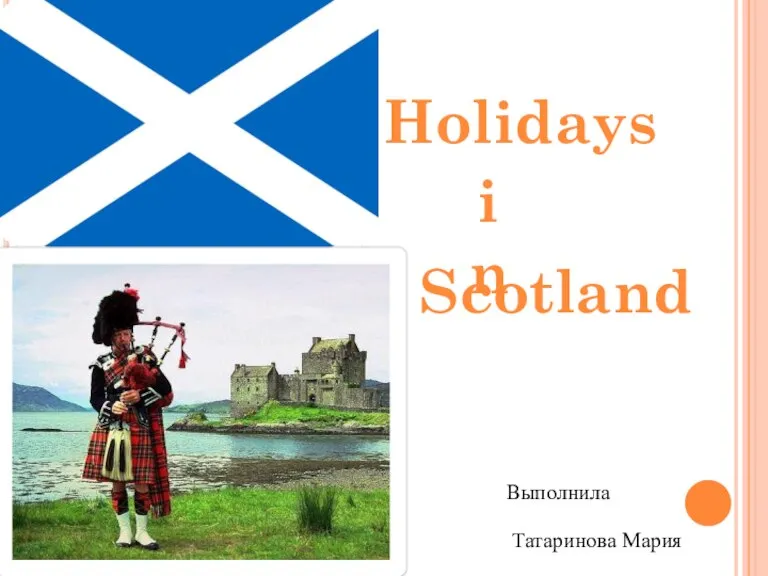
Holidays in Scotland
HOLIDAYS AND FESTIVALS IN SCOTLAND Most of us adore holidays because they provide us with new interests, new outlets of our energies, a break from work, and a good chance to have a rest. For centuries a holiday was simply considered to be a Holy Day, usually dedicated to one of the saints, on which no work was done. If the weather was fine everybody went out of town to the country for archery, wrestling, dancing and other out-door activities. In 1834 four Bank Holidays were officially introduced instead of the many odd Holy Days. Nowadays, there are six Public holidays in the UK Known as Bank Holidays, due to the fact that the banks were to be closed on those days. These are Good-Friday, Easter Monday, the last Monday in May – or the first Monday in June (Spring Bank Holiday) the last Monday in August or the first Monday in September ( the Summer Bank Holiday), Christmas Day and Boxing Day (the day after Christmas Day). Though most of the holidays are of religious origin, for many people they are simply days, on which people have a rest, relax and make merry. The majority of the public holidays are movable, that is they do not fall on the same day each year and the particular dates are fixed annually. Besides Bank Holidays, there are many other festivals, anniversaries and simply days, such as a Pancake Day or Guy Fawkes Day Night, on which certain traditions are observed, but they are ordinary working days. BELTANE Beltane or Beltaine is the festival held on the first day of May. Beltane was an ancient Gaelic festival celeb rated in Ireland, Scotland and the Isle of Man. It marked the beginning of summer. It is a cross-quarter day, marking the midpoint in the Sun's progress between spring equinox and summer. The astronomical date for this midpoint is nearer to 5 May or 7 May. Beltane regained popularity during the Celtic Revival and is still observed as a cultural festival by some people in Ireland, Scotland, the Isle of Man and among their diasporas. Today, Beltane is also observed as a religious festival by Celtic neopagans. Wiccans adopted the name Beltane for their May festival.
Продолжить чтение
About Australia
About Australia
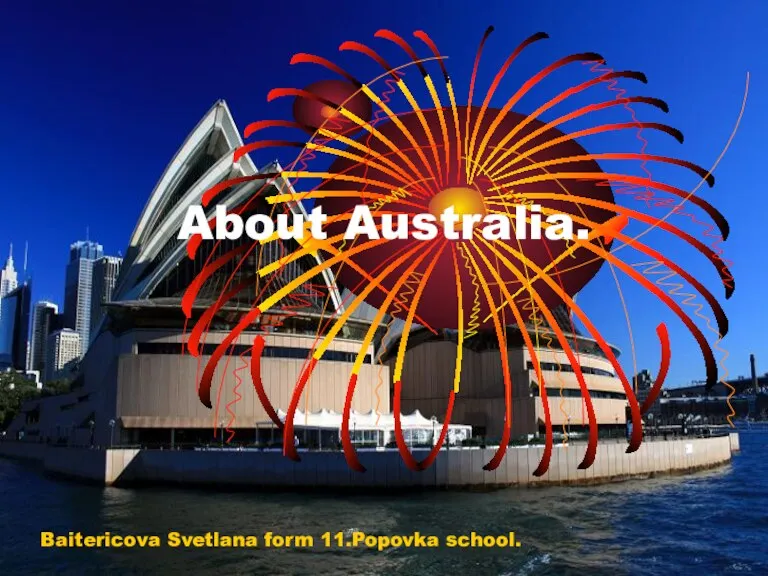
Australia’s Unique History Captain James Cook discovered Australia in 1770.He was sent to discover the huge land that many people believed was south of the equator.He landed south of present day Sydney in New South Wales.He claimed this part of the land for the King of England. At this time England was having many social problems. Unemployment was high.Crime was one of the greatest problems.The government punished people by sending them to prison.England’s solution to crowded prisons was to send priso- ners to far colonies .They could work off their prison sentences as labou- rers in the new colonies and eventually earn their freedom.Therefere, in 1788 Captain Arthur Phillip commanded eleven ships to Australia.About 750 of the 1000 people on the ships were convicts.These first settlers were greeted by the Aboriginers, the first inhabitants of Australia.There were an estimated 300000 Aborigines living in Australia at that time. Great Britain claimed all of Australia in 1827.In 1851 gold was discovered about 300 km west of Sydney.People rushed to the gold fields to find their fortunes.This attracted robbers called bushrangers.Ned Kelly was a famous bushranger.He was a very clever outlaw. In 1901 Australia become a nation within the British Empire under Queen Victoria’s rule.It was called the Commonwealth of Australia.Australia had a very limited constitution.Great Britain continued to make decisions re- garding all of Australia’s foreign affairs. In 1931 Australia gained independense from Great Britain. The land Australia is the only nation that occupies a whole continent.It’s an island of 7.7 million square kilometers.It is the sixth largest country in the world after Russia Canada China the United States of America and Brasil.It’s located to the south of Asia between the Pasific and Indian oceans. Australia is the flattest continent after Antarctica.It is also the world’s driest continent.
Продолжить чтение
Предпереводческий анализ текста
Пояснительная записка Данная программа предназначена для подготовки студентов по направлению 500520 Лингвистика на степень Бакалавра лингвистики и полностью соответствует Государствен-ному образовательному стандарту подготовки студентов по направлению Лингвистика. Курс читается в качестве факультативного в 5 и 6 семестрах (третий год обучения) и пред-шествует дисциплине Теория и практика перевода, читаемому на 4 курсе.  Обучение переводу является необходимой составляющей профессиональной подго-товки преподавателя, лингвиста, переводчика. В рамках когнитивно-коммуникативной па-радигмы обучения иностранному языку с учетом достижений лингвистики в целом и тео-рии обучения языкам успешно развивается подход, основанный на последовательном сравнении лингвокультурных концептов и представлений. Этот подход представляется перспективным в связи с тем, что позволяет через сравнение того, как представлены в язы-ках перевода особенности менталитета и культурно и исторически обусловленные расхож-дения в структурах обоих языков, прийти к пониманию глубинных своеобразий каждого из языков, установить между ними соответствия и предоставить студентам хорошо обосно-ванные систематические сведения, которые позволят в итоге создать адекватный перевод.  Составной частью такого подхода должен стать когнитивный анализ структурно-се-мантических особенностей исходного текста (на фоне регулярно соотносимых с ними структурно-семантических особенностях языка перевода) и в итоге создание алгоритми-ческого переводческого решения, некоего «подстрочника» для перевода. Данный курс предназначен для решения именно таких задач и может служить основой для изучения курса теории и практики перевода.   Тематический план   Тема занятия К-во аудиторн. К-во часов на часов самостоят. работу Общая характеристика строя русского как исход- ного языка и английского языка как языка перевода 6 8 Особенности структуры предложения в русском 10 22 языке и трудности их перевода на английский язык Редуцированная предикативность в русском отглагольном существительном как потенциальная трудность перевода 6 8 Экспрессивно-стилистические характеристики русско- го языка как источник возможных трудностей перевода 10 10 Прагматическая адаптация русского текста 6 10 Общие структурные особенности английского и
Продолжить чтение
British theatre
British theatre
Theatre was introduced from Europe to what is now the United Kingdom by the Romans and auditoriums were constructed across the country for this purpose. By the medieval period theatre had developed with the mummers' plays, a form of early street theatre associated with the Morris dance, concentrating on themes such as Saint George and the Dragon and Robin Hood. These were folk tales re-telling old stories, and the actors travelled from town to town performing these for their audiences in return for money and hospitality. The medieval mystery plays and morality plays, which dealt with Christian themes, were performed at religious festivals. Theatre of the United Kingdom plays an important part in British culture, and the UK has had a vibrant tradition of theatre since at least 1585. The reign of Elizabeth I in the late 16th and early 17th century saw a flowering of the drama and all the arts. At this time appeared the man who became an English poet and playwright, widely regarded as the greatest writer in the English language and the world's pre-eminent dramatist. He is often called England's national poet and the "Bard of Avon". His surviving works, including some collaborations, consist of about 38 plays, 154 sonnets, two long narrative poems, and several other poems. His plays have been translated into every major living language and are performed more often than those of any other playwright. The New Era of the Theatre Yes, this man was William Shakespeare. He has founded the new era of the theatre.
Продолжить чтение