- Главная
- Английский язык
- Different question types

Содержание
Слайд 2Different question types
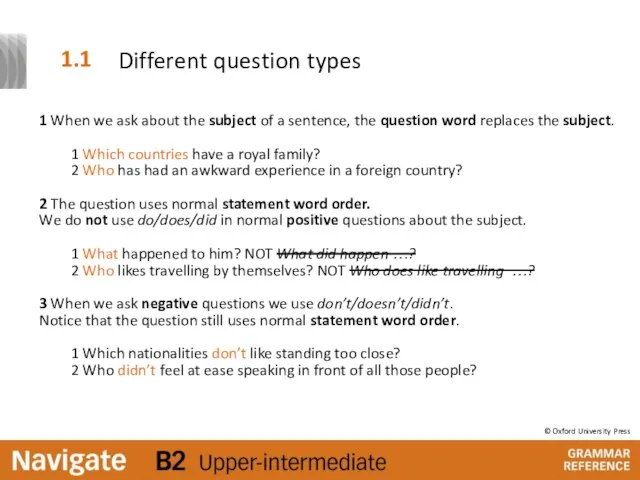
1 When we ask about the subject of a sentence,
Different question types
1 When we ask about the subject of a sentence,

the question word replaces the subject.
1 Which countries have a royal family?
2 Who has had an awkward experience in a foreign country?
2 The question uses normal statement word order.
We do not use do/does/did in normal positive questions about the subject.
1 What happened to him? NOT What did happen …?
2 Who likes travelling by themselves? NOT Who does like travelling …?
3 When we ask negative questions we use don’t/doesn’t/didn’t.
Notice that the question still uses normal statement word order.
1 Which nationalities don’t like standing too close?
2 Who didn’t feel at ease speaking in front of all those people?
1 Which countries have a royal family?
2 Who has had an awkward experience in a foreign country?
2 The question uses normal statement word order.
We do not use do/does/did in normal positive questions about the subject.
1 What happened to him? NOT What did happen …?
2 Who likes travelling by themselves? NOT Who does like travelling …?
3 When we ask negative questions we use don’t/doesn’t/didn’t.
Notice that the question still uses normal statement word order.
1 Which nationalities don’t like standing too close?
2 Who didn’t feel at ease speaking in front of all those people?
1.1
Слайд 3Different question types
1 If we begin a question with a phrase such
Different question types
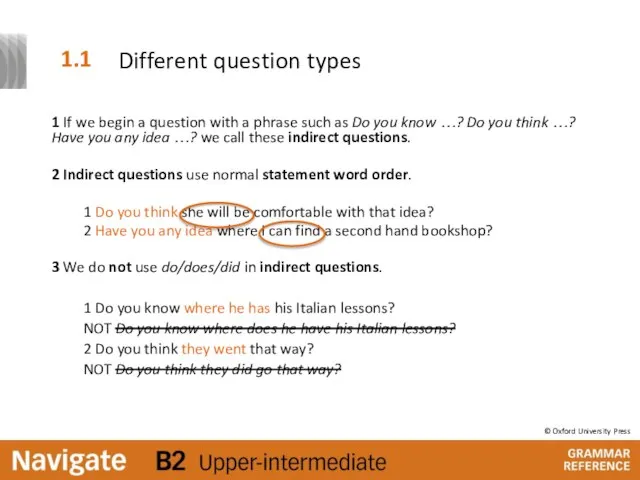
1 If we begin a question with a phrase such

as Do you know …? Do you think …? Have you any idea …? we call these indirect questions.
2 Indirect questions use normal statement word order.
1 Do you think she will be comfortable with that idea?
2 Have you any idea where I can find a second hand bookshop?
3 We do not use do/does/did in indirect questions.
1 Do you know where he has his Italian lessons?
NOT Do you know where does he have his Italian lessons?
2 Do you think they went that way?
NOT Do you think they did go that way?
2 Indirect questions use normal statement word order.
1 Do you think she will be comfortable with that idea?
2 Have you any idea where I can find a second hand bookshop?
3 We do not use do/does/did in indirect questions.
1 Do you know where he has his Italian lessons?
NOT Do you know where does he have his Italian lessons?
2 Do you think they went that way?
NOT Do you think they did go that way?
1.1
Слайд 4Different question types
1 When a question word is the object of a
Different question types
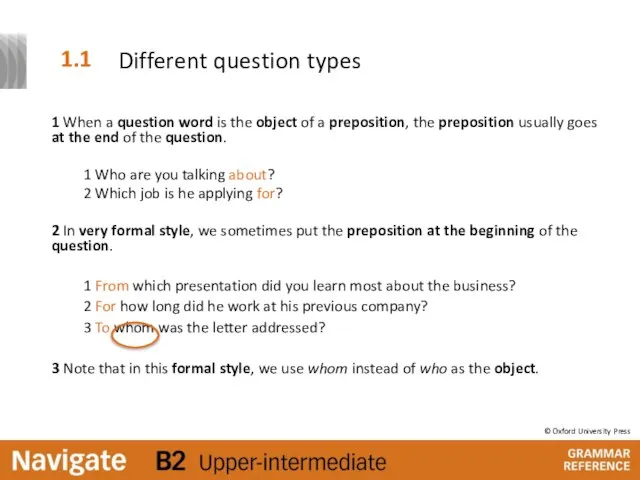
1 When a question word is the object of a

preposition, the preposition usually goes at the end of the question.
1 Who are you talking about?
2 Which job is he applying for?
2 In very formal style, we sometimes put the preposition at the beginning of the question.
1 From which presentation did you learn most about the business?
2 For how long did he work at his previous company?
3 To whom was the letter addressed?
3 Note that in this formal style, we use whom instead of who as the object.
1 Who are you talking about?
2 Which job is he applying for?
2 In very formal style, we sometimes put the preposition at the beginning of the question.
1 From which presentation did you learn most about the business?
2 For how long did he work at his previous company?
3 To whom was the letter addressed?
3 Note that in this formal style, we use whom instead of who as the object.
1.1
- Предыдущая
Эко-тропа Орланьи КручиСледующая -
Разминка для болельщиков
Причастие. The participle
Tourism in South Korea
Водные виды спорта. Unit 5. Lesson 7
Формулы сокращенного умножения. Тест
Leonardo da Vinci (1452 - 1519)
Weather. Sunny. Rainy
Mad Fun Interactive Book Kids Reading
Презентация на тему Tower of London
Present Tenses
Sports
Russian – Japanese bilateral relations
Множественное число имен существительных
Rainbow English game
Hostel
Quiz
Where is the dog, the cat and the troll
10 sights of the world
CAE Speaking
Homework
Template for project
Regular plurals-1
Part 1. Home test part 2
Interpol
Презентация на тему Экстремальные виды спорта
Phrasal verbs
St. Jerome (347-420 AD) is the patron saint of translators
What is the coronavirus?
Preparation for ENT – 2016: synonyms / antonyms / translations