Презентации, доклады, проекты без категории

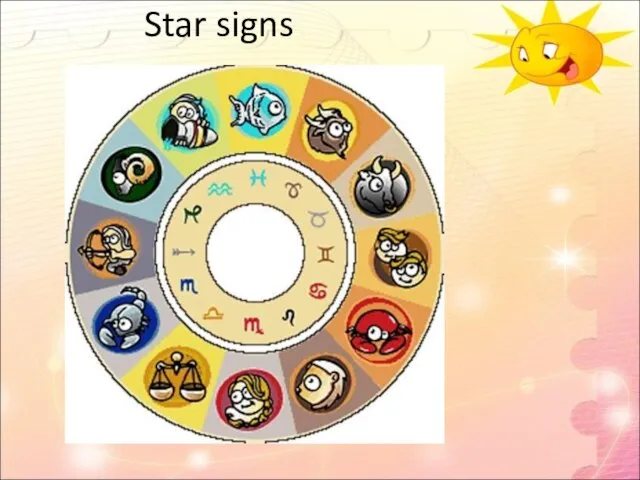
Star signs
Star signs
Aquarius - January 21 - February 19 Pisces - February 20- March 20 Aries - March 21 - April 20 Taurus - April 21 - May 21 Gemini - May 22 - June 21 Cancer - June 22 - July 22 Leo - July 23 -August 21 Virgo - August 22 - September 23 Libra - September 24 - October 23 Scorpio - October 24 - November 22 Sagittarius - November 23 - December 22 Capricorn - December 23 - January 20 Aries Strength Keywords: Aries Weakness Keywords: - Independent - Moody - Generous - Short-tempered - Optimistic - Self-involved - Enthusiastic - Impulsive - Courageous - Impatient Aries in a Nutshell: Independence is key to Aries astrology, they do not like to take orders from others and enjoy getting their way. Their magnetic personality often entices others to follow their lead because Aries personalities bring excitement into others lives. Aries are good friends, they always look out for their friends with caring and generosity and encourage them with their natural optimism. If confronted, Aries can turn to be quite childish, they will fight back by all means. If a business idea comes their way, they tend to plunge right in. However, if success is not immediate, they tend to lose interest and give up easily. Aries are notorious for not finishing what they have begun. This is due to the low tolerance for boredom and lack of patience. Aries easily take offense to comments made. Aries are self-involved and can be self-centered. They are not very good liars and other people can usually see through them. Underneath the strong, independent surface may lie insecurity. This is due to the intense drive to succeed and Aries put too much pressure on themselves, thus resulting in self-doubt. Aries tend to live adventurous lives and like to be the center of attention, but rightly so since they are natural, confident leaders. Aries are enthusiastic about their goals and enjoy the thrill of the hunt.
Продолжить чтение
School uniform in different countries
Cambodia Uniforms take a role in began the fashion for Cambodia society today. Before, school uniform became free for students just a white shirt, a blue or black skirt and trousers. In recent years, school uniform transferred into more strong and hard, suitable more for education. From Primary to Secondary school uniform allowed a male student and a female student in the way they wanted but follow the style that school allowed. However, in high school, the female student must worn the skirt not up their high but down their knees. Uniforms are a common part of schools in China. Almost all secondary schools as well as some elementary schools require students to wear uniforms. Uniforms in mainland China usually consist of two sets, one for summer and other for winter. Uniforms for boys in winter usually consist of a zip up sweater and pants, and a collared shirt (usually white) with shorts or pants. The uniforms for girls in winter are basically the same as the boys' uniform. However, summer uniform for girls does not consist only of a coloured shirt and pants, they also have the option of a skirt. Germany   School uniforms have no strong tradition in Germany and are virtually unknown today.   From the 16th century, students (especially of secondary or grammar schools and similar institutions) were often subject to regulations that prescribed, for example, modest and not too stylish attire. In many cases these regulations were part of wider laws concerning the clothing of all citizens of certain social classes. A blue coat became a widespread, obligatory status symbol of students of secondary schools; it fell out of use during the later half of the 18th century. In newer times, school uniforms in any real sense did not exist outside of convent schools and private boarding schools. At times, certain fashions became so widespread that they approached uniform status; this is true in particular for so-called student hats that became widespread from the 1880s on and remained somewhat popular until they were banned by the Nazis. Their wearing was advocated by teachers and students themselves and occasionally made mandatory, but never on a national or state-wide level. Another instance are the sailor suits that became fashionable around the turn of the 19th century. These were not usually a prescribed uniform.
Продолжить чтение
New food
New food
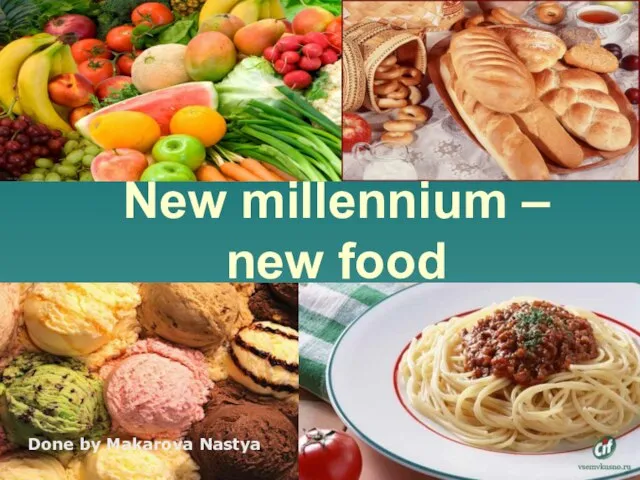
We get food from animals and birds, plants and fishes. We get meet from cow, pig and sheep. From cow we also get milk. From cow we get beef, from pig we get pork, bacon and ham, from sheep we get mutton. We get poultry and egg from hen and duck. We grow wheat, oats, maize and other cereals in the field. From them we make flour we bake bread, cakes and biscuits. We eat cereals, especially cornflakes for breakfast. We also eat various kinds of vegetables, fruits and berries: potatoes, cabbages, cauliflower, beetroot, carrots, onions, tomatoes, radishes and cucumbers. We eat apples, pears, apricots, peaches, grapes, bananas and orange. We grow strawberries, gooseberries, raspberries, black currants, red currants and white currants. We boil, fry and roast meat and fish. We usually boil vegetables. Englishmen like fried potatoes very much, they call them ‘chips’. In spring, summer and autumn, we eat fresh fruit raw; in winter we eat preserved fruit. We drink tea, coffee, cocoa, milk, wine and beer. I drink coffee with milk for my breakfast. There are four meals a day in an English home: breakfast, lunch, tea and dinner. Breakfast is the first meal of the day. It is at about 8 o’clock in the morning and consists of porridge with milk and salt or sugar, eggs boiled fried, bead and butter with marmalade or jam. Some people like to drink tea, but others prefer coffee. Instead of porridge they may have fruit, juice or they may prefer biscuits. Lunch. The usual time for lunch is 1 o’clock. This meal starts with soup or fruit juice. Then follows some meat or poultry with potatoes boiled or fried, carrots and beans. Then a pudding comes. Instead of the pudding they may prefer cheese and biscuits. Last of all coffee- black or white. Englishmen often drink something at lunch. Water is usually on the table. Some prefer juice or lemonade. Tea is the third meal of the day. It is between 4 or 5 o’clock, the so-called 5 o’clock tea. On the table there is tea, milk or cream, sugar, bread and butter, cakes and jam. Friends and visitors are often present at tea. Dinner is the fourth meal of the day. The usual time is about 7 o’clock and all the members of the family sit down together. Our food Dinner usual consists of soup, fish or mat with vegetables- potatoes, green beans, carrot and cabbage, sweet pudding, fruit salad, ice-cream or cheese and biscuits. Then after a talk they have black or white coffee. So the four meals of the day are either breakfast, dinner, tea, supper or breakfast, lunch, tea, dinner. II like potatoes that I why I asked 28 children several questions about them. My classmates like: mashed and boiled and free boiled 12 children prefer free potatoes. 7 children prefer mashed potatoes And 9 children prefer boiled potatoes. As for me I prefer mashed potatoes. About drinking the opinions are different too. 8 children prefer drinking coffee. 11 children prefer drinking And 7 children prefer drinking tea. I prefer drinking tea.
Продолжить чтение