History of life
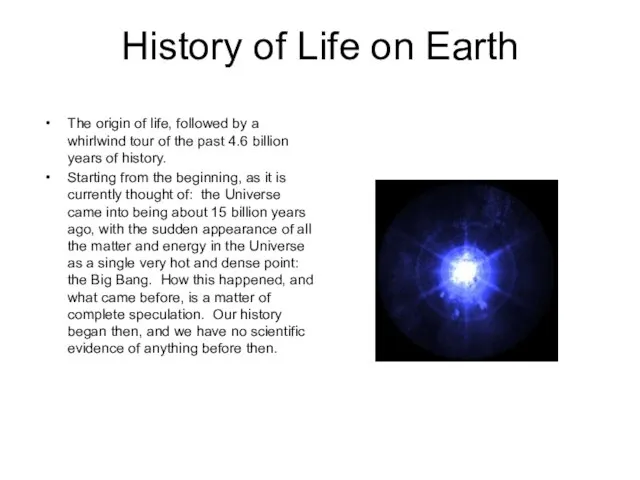
Formation of the Solar System About 4.6 billion years ago, the Sun and the planets formed. We know this because radioactive dating of rocks found on the Moon, meteorites, and Earth rocks all give this as the maximum date At that time, dust particles began to accrete into larger particles. Possibly there was a supernova (explosion of a star) nearby to get things started. Once particles join into larger units, their gravity attracts more particles, forming larger objects. Eventually planet-sized objects appear. For a long time after the initial formation of the Solar System, large objects collided with each other, producing craters such as we see on the Moon today. Earth no longer has these craters due to weathering and movements of the Earth’s crust. Earth probably didn’t have a solid crust until about 4 billion years ago. Geological Ages We can divide the history of life on Earth into six main stages: Hadean Era: from the formation of the Earth about 4.6 billion years ago until about 4 billion years ago. The Earth’s surface is constantly bombarded by large objects which repeatedly melt the whole surface, making life impossible. Archean Era: from 4 to 2 billion years ago (very roughly). Origin of life, all life is single celled bacteria. No oxygen in the atmosphere. Proterozoic Era. 2 billion until 550 million years ago. Oxygen appears in the atmosphere and builds to approximately the present level of 21%. Eukaryotes appear. No hard parts: bone, teeth, shells, so very few fossils. the first three eras are collectively called the Pre-Cambrian era Paleozoic Era. 550 to 250 million years ago. Fossils appear, complex multicellular organisms, invasion of the land by plants and animals. Mesozoic Era. 250 to 65 million years ago. Appearance of mammals and flowering plants, but the land is dominated by dinosaurs (reptiles). Cenozoic Era. 65 million years ago until present. Land dominated by mammals and flowering plants.
 Slaidy.com