Содержание
- 2. Simple Tenses A Simple tense is a form of a verb that simply shows when the
- 3. Progressive (Continuous) Tenses
- 4. A Progressive tense is a form of a verb that shows the action is in progress.
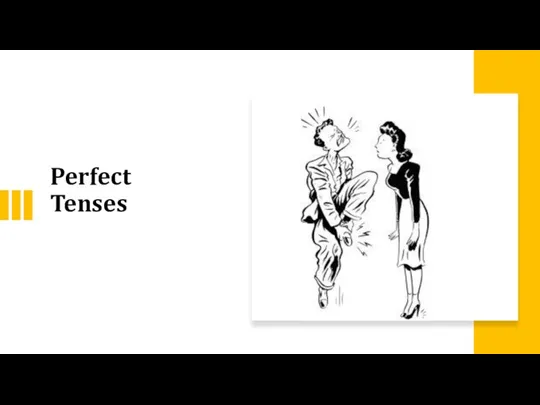
- 5. Perfect Tenses
- 6. PERFECT means "complete, finished". A Perfect tense is a form of a verb that shows the
- 7. Perfect continuous/ progressive tenses
- 8. A Perfect Progressive tense is a form of the verb that shows the action started, continued,
- 10. 'Used to + гл н.ф.': Используем, когда говорим о действиях или состояниях из прошлого, которых сейчас
- 11. 'Be used to' Мы используем “be+ глагол-ing", чтобы говорить о вещах, которые кажутся нам нормальными, или
- 12. Мы можем использовать “get used to + глагол-ing", чтобы говорить о смене непривычного на привычное. Мы
- 13. Мы также можем использовать “would + гл н.ф.", чтобы говорить о привычке или повторяющемся действии в
- 14. to come across- случайно встретиться to come into- получить наследство to come back - возвращаться to
- 16. Скачать презентацию
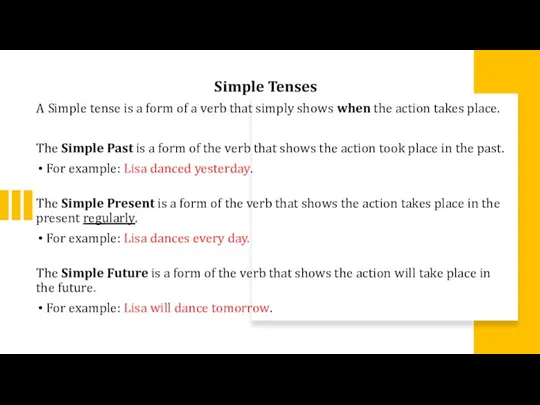
Слайд 2 Simple Tenses
A Simple tense is a form of a verb that
Simple Tenses
A Simple tense is a form of a verb that

simply shows when the action takes place.
The Simple Past is a form of the verb that shows the action took place in the past.
For example: Lisa danced yesterday.
The Simple Present is a form of the verb that shows the action takes place in the present regularly.
For example: Lisa dances every day.
The Simple Future is a form of the verb that shows the action will take place in the future.
For example: Lisa will dance tomorrow.
The Simple Past is a form of the verb that shows the action took place in the past.
For example: Lisa danced yesterday.
The Simple Present is a form of the verb that shows the action takes place in the present regularly.
For example: Lisa dances every day.
The Simple Future is a form of the verb that shows the action will take place in the future.
For example: Lisa will dance tomorrow.
Слайд 3Progressive (Continuous) Tenses
Progressive (Continuous) Tenses
Слайд 4A Progressive tense is a form of a verb that shows the
A Progressive tense is a form of a verb that shows the
action is in progress. Or in other words, that it continues.
The Past Progressive is a form of the verb that shows the action was in progress at some time in the past.
For example: Lisa was dancing yesterday at 8 o'clock.
The Present Progressive is a form of the verb that shows the action is in progress in the present.
For example: Lisa is dancing right now.
The Future Progressive is a form of the verb that shows the action will be in progress at some time in the future.
For example: Lisa will be dancing tomorrow at 8 o'clock.
The Past Progressive is a form of the verb that shows the action was in progress at some time in the past.
For example: Lisa was dancing yesterday at 8 o'clock.
The Present Progressive is a form of the verb that shows the action is in progress in the present.
For example: Lisa is dancing right now.
The Future Progressive is a form of the verb that shows the action will be in progress at some time in the future.
For example: Lisa will be dancing tomorrow at 8 o'clock.
Слайд 5Perfect Tenses
Perfect Tenses

Слайд 6PERFECT means "complete, finished".
A Perfect tense is a form of a verb
PERFECT means "complete, finished".
A Perfect tense is a form of a verb
that shows the action is complete. It means the action is finished.
The Past Perfect is a form of the verb that shows the action was complete before some time in the past.
For example: Lisa had danced before she came.
The Present Perfect is a form of the verb that shows the action was complete before the present.
For example: Lisa has already danced.
The Future Perfect is a form of the verb that shows the action will be complete before some time in the future.
For example: Lisa will have danced tomorrow by 9 o'clock.
The Past Perfect is a form of the verb that shows the action was complete before some time in the past.
For example: Lisa had danced before she came.
The Present Perfect is a form of the verb that shows the action was complete before the present.
For example: Lisa has already danced.
The Future Perfect is a form of the verb that shows the action will be complete before some time in the future.
For example: Lisa will have danced tomorrow by 9 o'clock.
Слайд 7Perfect continuous/
progressive tenses
Perfect continuous/
progressive tenses
Слайд 8A Perfect Progressive tense is a form of the verb that shows
A Perfect Progressive tense is a form of the verb that shows
the action started, continued, and was complete until some point.
The Past Perfect Progressive is a form of the verb that shows the action started in the past and continued until some point in the past.
For example: Lisa had been dancing for 2 hours before she was tired.
The Present Perfect Progressive is a form of the verb that shows the action started in the past and continued until the present.
For example: Lisa has been dancing for 3 hours without stopping!
The Future Perfect Progressive is a form of the verb that shows the action will continue until some point in the future.
For example: By tomorrow morning, Lisa will have been dancing for 12 hours!
The Past Perfect Progressive is a form of the verb that shows the action started in the past and continued until some point in the past.
For example: Lisa had been dancing for 2 hours before she was tired.
The Present Perfect Progressive is a form of the verb that shows the action started in the past and continued until the present.
For example: Lisa has been dancing for 3 hours without stopping!
The Future Perfect Progressive is a form of the verb that shows the action will continue until some point in the future.
For example: By tomorrow morning, Lisa will have been dancing for 12 hours!
Слайд 10'Used to + гл н.ф.':
Используем, когда говорим о действиях или состояниях из
'Used to + гл н.ф.':
Используем, когда говорим о действиях или состояниях из
прошлого, которых сейчас нет.
For example: I used to have long hair (but now I have short hair).
He used to smoke (but now he doesn't smoke).
Watch out! With the negative and the question it's 'use' and not 'used’:
For example: Did you use to be a teacher?
She didn't use to like chocolate, but she does now.
For example: I used to have long hair (but now I have short hair).
He used to smoke (but now he doesn't smoke).
Watch out! With the negative and the question it's 'use' and not 'used’:
For example: Did you use to be a teacher?
She didn't use to like chocolate, but she does now.
Слайд 11 'Be used to'
Мы используем “be+ глагол-ing", чтобы говорить о вещах, которые
'Be used to' Мы используем “be+ глагол-ing", чтобы говорить о вещах, которые
кажутся нам нормальными, или о вещах, к которым мы привыкли:
For example: I'm used to getting up early, so I don't mind doing it (= getting up early is normal for me, it's what I usually do).
Note that we make the negative or the question with the verb 'be' in the normal way. The 'used to' doesn't change:
For example: Lucy isn't used to staying up late, so she's very tired today.
Are your children used to walking a lot?
Мы также можем использовать ‘be used to + существительное', которое имеет то же значение:
For example: I've lived in the UK almost all my life, so I'm used to rain (= rain is normal for me).
Мы можем поместить глагол "быть" в любое время. Таким образом, мы можем говорить о вещах в прошлом или будущем, а также о настоящем, используя это выражение:
For example: It was difficult when I first started university, because I wasn't used to the amount of work we had to do.
Soon I'll be used to driving in London and I won't be so frightened!
For example: I'm used to getting up early, so I don't mind doing it (= getting up early is normal for me, it's what I usually do).
Note that we make the negative or the question with the verb 'be' in the normal way. The 'used to' doesn't change:
For example: Lucy isn't used to staying up late, so she's very tired today.
Are your children used to walking a lot?
Мы также можем использовать ‘be used to + существительное', которое имеет то же значение:
For example: I've lived in the UK almost all my life, so I'm used to rain (= rain is normal for me).
Мы можем поместить глагол "быть" в любое время. Таким образом, мы можем говорить о вещах в прошлом или будущем, а также о настоящем, используя это выражение:
For example: It was difficult when I first started university, because I wasn't used to the amount of work we had to do.
Soon I'll be used to driving in London and I won't be so frightened!
Слайд 12Мы можем использовать “get used to + глагол-ing", чтобы говорить о смене
Мы можем использовать “get used to + глагол-ing", чтобы говорить о смене
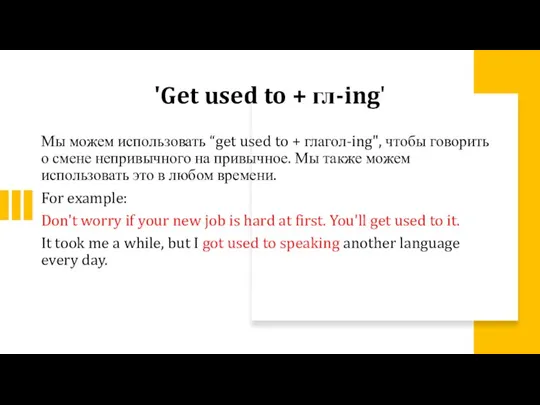
непривычного на привычное. Мы также можем использовать это в любом времени.
For example:
Don't worry if your new job is hard at first. You'll get used to it.
It took me a while, but I got used to speaking another language every day.
For example:
Don't worry if your new job is hard at first. You'll get used to it.
It took me a while, but I got used to speaking another language every day.
'Get used to + гл-ing'
Слайд 13Мы также можем использовать “would + гл н.ф.", чтобы говорить о привычке
Мы также можем использовать “would + гл н.ф.", чтобы говорить о привычке
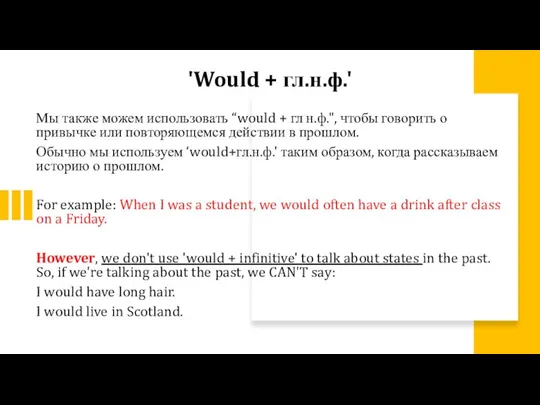
или повторяющемся действии в прошлом.
Обычно мы используем ‘would+гл.н.ф.' таким образом, когда рассказываем историю о прошлом.
For example: When I was a student, we would often have a drink after class on a Friday.
However, we don't use 'would + infinitive' to talk about states in the past. So, if we're talking about the past, we CAN'T say:
I would have long hair.
I would live in Scotland.
Обычно мы используем ‘would+гл.н.ф.' таким образом, когда рассказываем историю о прошлом.
For example: When I was a student, we would often have a drink after class on a Friday.
However, we don't use 'would + infinitive' to talk about states in the past. So, if we're talking about the past, we CAN'T say:
I would have long hair.
I would live in Scotland.
'Would + гл.н.ф.'
Слайд 14to come across- случайно встретиться
to come into- получить наследство
to come back -
to come across- случайно встретиться
to come into- получить наследство
to come back -
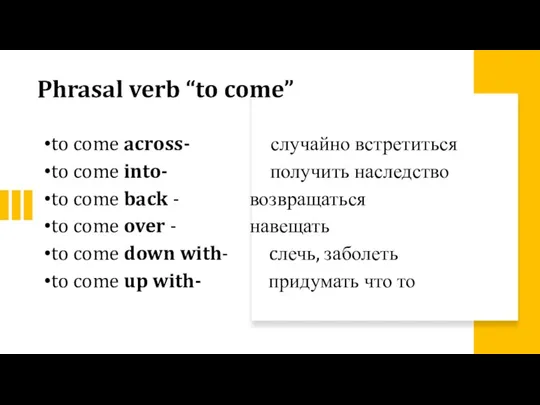
возвращаться
to come over - навещать
to come down with- cлечь, заболеть
to come up with- придумать что то
to come over - навещать
to come down with- cлечь, заболеть
to come up with- придумать что то
Phrasal verb “to come”
- Предыдущая
Брендинг. Теоретические основы брендингаСледующая -
Методы кинематографа. 9 класс
Культура Западной Европы 17-18 веков
Что едят русские по мнению иностранцев
Памятники русской архитектуры XVII
“Исследование космических лучей на аэростатных высотах (эксперимент “СФЕРА”)” за 2005 г.
Ораторское мастерство
План розвитку Великобудищанської спеціалізованої школи І-ІІІ ступенів
Banket-chay_20
Коммуникационные технологии во внешнеэкономической деятельности предприятия
Новая линейка комбо устройств MiVue iсерии
Конфликты в школе. Профилактика конфликтов в школьной среде, поиск путей предотвращения и преодоления конфликтных ситуаций
Что такое светская этика (4 класс)
Варвари біля воріт Принципи корпоративного управління
Как получается мёд
Физиология мотивации
Лидер детского молодежного объединения
Личная гигиена спортсмена
Коммерческое предложение по установке КМС-400/1
Ференц Лист
Предприятие-субъект предпринимательской деятельности
ОРГАНИЗАЦИЯ ТЕКУЩЕГО КОНТРОЛЯ И ПРОМЕЖУТОЧНОЙ АТТЕСТАЦИИ СТУДЕНТОВС ИСПОЛЬЗОВАНИЕМ БАЛЛЬНО-РЕЙТИНГОВОЙ СИСТЕМЫ ОЦЕНКИ УСПЕВАЕ
Организация здоровьесберегающей среды в школе
Презентация на тему КРАСНОДАР
жылу баланс (1)
Праздник весны и труда. 1 Мая
Учитель основ безопасности жизнедеятельности школы №84 Горлов Сергей Сергеевич
Землетрясения Подготовила презентацию студентка 1ого курса ЭФ Группы Э112Б Олефир Карина
Modern China
Правовое положение личности