Презентации, проекты, доклады в PowerPoint на любую тему

PDM - системы управления изделием
CAD – конструирование илделия; CAE – системы расчета элементов изделия; CAM – системы расчета управляющих программ; CAPP системы проектирования технологических процессов; PDM –системы (Product Date Management) система управления изделием. Примечание: Базовые системы PLM - решений Одновременно PDM-система является базовым средством, с помощью которого реализуется единое информационное пространство для всех этапов жизненного цикла изделия. Возможности PDM –системы : распараллеливание процессов проектирования объектов и процессов; синхронизация проведения изменений на основе приема RedLine; отслеживание жизненного цикла технологических документов; контроль процесса управления на основе технология «workflow»; быстрый авторизованный доступ к документам и моделям на основе электронного архива; работа над проектом удаленных пользователей через Интернет.
Продолжить чтение
Теория Информации
Теория Информации
Mathematical Backgrounds. Information Theory In 1949, Shannon provides a theoretical foundations for cryptography based on his fundamental work on information theory. He measured the theoretical secrecy of a cipher by the uncertainty about the plaintext given the received ciphertext. If, no matter how much ciphertext is intercepted, nothing can be learned about the plaintext, the cipher achieves perfect secrecy. Entropy and Equivocation Information theory measures the amount of information in a message by the average number of bits needed to encoded all possible messages in an optimal encoding. The Sex field in a database, for example, contains only one bit of information because it can be encoded with one bit (Male can be represented by “0”, Female by “1”). If the field is represented by an ASCII character encoding of the character strings “MALE” and “FEMALE”, it will take up more space, but will not contain any more information. Mathematical Backgrounds. Information Theory The amount of information in a message is formally measured by the entropy of the message. The entropy is a function of the probability distribution over the set of all possible messages. Let X1,..., Xn be n possible messages occurring with probabilities p(X1),...,p(Xn), the sum of this probabilities p(Xi), i=1,...,n equals to one. The entropy of a given message is defined by the weighted average: H(X)=−Σinp(Xi)log2 p(Xi). As the sum taken over all messages X: H(X)=–ΣXp(X)log2 p(X)=ΣXp(X)log2 [1/p(X)].
Продолжить чтение
Теория Информации
Теория Информации
Encryption Algorithms Transposition Cipher A lot of codes are simple in design. Just by changing the order of words, letters, or the way read them can turn the message into secret code. The simplest examples of the Transposition Ciphers are: Lumping Words (Format) Get rid of spaces and returns to lump words together. Use upper case to make the code harder to read and decode. Ciphertext: THISISHARDCODEFORMANYPEOPLE Message: THIS IS HARD CODE FOR MANY PEOPLE Character Bloks Block letter of a message by 2,3 or more characters. Ciphertext: TH IS IS HA RD CO DE FO RM AN YP EO PL E Message: THIS IS HARD CODE FOR MANY PEOPLE Backwards English Writing words, sentences, or entire message backwards can be very confusing! Ciphertext: SIHT SI DRAH EDOC ROF YNAM ELPOEP Message: THIS IS HARD CODE FOR MANY PEOPLE Reading SIHT backwards yields the answer THIS. Encryption Algorithms Transposition Cipher Transposition cipher rearrange characters according to some scheme. This rearrangement was classically done with the aid of some type of geometric figure. Enciphering procedure consists of two steps as shown next: Plaintext Figure Ciphertext Write-in Take-off First, the plaintext was written into the figure according to some “Write-in” path, then the ciphertext was taken off the figure according to some “Take-off” path. Example 2.1. Suppose that the plaintext CRYPTOGRAPHY is written into 3 rows by 4 columns matrix by rows as follows: 1 2 3 4 C R Y P T O G R A P H Y If the columns are taken off in the order 3-1-4-2, the resulting ciphertext is YGHCTAPRYROP.
Продолжить чтение
Methods and types of archiving
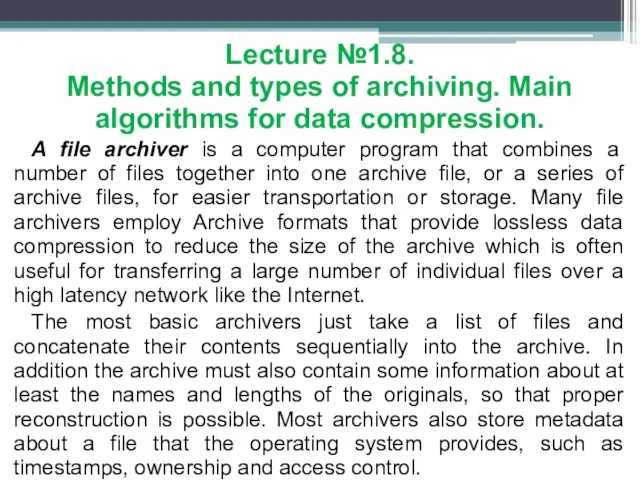
The process of making an archive file is called archiving or packing. Reconstructing the original files from the archive is termed unarchiving, unpacking or extracting. An archive file is a file that is composed of one or more files along with metadata that can include source volume and medium information, file directory structure, error detection and recovery information, file comments, and usually employs some form of lossless compression. Archive files may also be encrypted in part or as a whole. Archive files are used to collect multiple data files together into a single file for easier portability and storage. Computer archive files are created by File archiver software, Optical disc authoring software, or Disk image software that uses an archive format determined by that software. The file extension or file header of the archive file are indicators of the file format used. Archive files are sometimes accompanied by separate parity archive (PAR) files that allow for additional error detection and recovery, particularly in recovery of missing package files in a multi-file archive. Archives can have extensions like .zip, .rar, .tar and etc. Lossless data compression is a class of data compression algorithms that allows the exact original data to be reconstructed from the compressed data. The term lossless is in contrast to lossy data compression, which only allows an approximation of the original data to be reconstructed, in exchange for better compression rates. Lossless data compression is used in many applications. For example, it is used in the popular ZIP file format and in the Unix tool gzip. It is also often used as a component within lossy data compression technologies.
Продолжить чтение