Слайд 2Syllabus
1. Demand, supply and market price
2. The price mechanism and market failure
3.
Some application of price theory
4. The basis of demand
5. The laws of returns
6. Perfect competition, imperfect competition, monopoly, price discrimination
7. National income and its measurement. Investments
8. Aggregate demand and aggregate supply
9. Money and the creation of bank deposits, monetary control
10. Inflation, value of money
11. Exchange rate systems
12. Public finance and taxation
13. Exam
Слайд 3Textbook
Rios, M. C., McConnell, C. R., & Brue, S. L. (2013). Economics:
Principles, problems, and policies. McGraw-Hill.
Study Guide for Economics, Nineteenth Edition Campbell R. McConnell, Stanley L. Brue, Sean M. Flynn, and William B. Walstad
Students are responsible for chapters
1-7, 9-14, 15-17, 19-20, 26-37
Слайд 5Required reading
Besides the lectures and the homework, you will be supposed to

read at least one of the chapters of the book each week (preferably more than one) so that at the end of the semester you finish reading all the required chapters and watching all the videos and have done all the homework.
Слайд 6Requirements to get the credits for the course
Attendance – 20% of the

grade.
Final test (exam) - 80% of the grade
 Slaidy.com
 Уральский экономический район (Географическое положение, природные условия и ресурсы)
 Динамика изменения цен на сахар. причины Подготовила: Клеутина С.А. ДС_01
 Опорный конспект лекций и содержательно-логические схемы по теме: Экономическая теория: предмет и метод
 Анализ Германии
 Организационные стандарты кредитного кооператива
 Основные понятия и категории экономической науки
 Краткая экономическая история России до 1917 года
 Бизнес-план кофейни
 Кривая Филлипса
 Издержки производства
 Типы безработицы
 Взаимосвязь понятий общество и экономика
 Понятие глобализации
 Решение задач - основы
 Кадры предприятия
 Региональная экономика
 Спрос, предложение и рыночное равновесие. ВК. 3.1
 Издержки и прибыль фирмы
 Кадры организации и производительность труда
 Международное географическое разделение труда
 Государственный долг, его влияние на макроэкономическую устойчивость и финансовую стабильность
 Аккредитивная форма безналичного расчёта.
 Актуальность, назначение и позиционирование в учебном процессе базового курса
 Сферы производства, предметы труда и процесс профессиональной деятельности
 Глобализация
 Экономика предприятия. Предприятие, как субъект хозяйствования. Основные признаки фирмы, их классификация. Издержки предприятия
 Государство и экономика
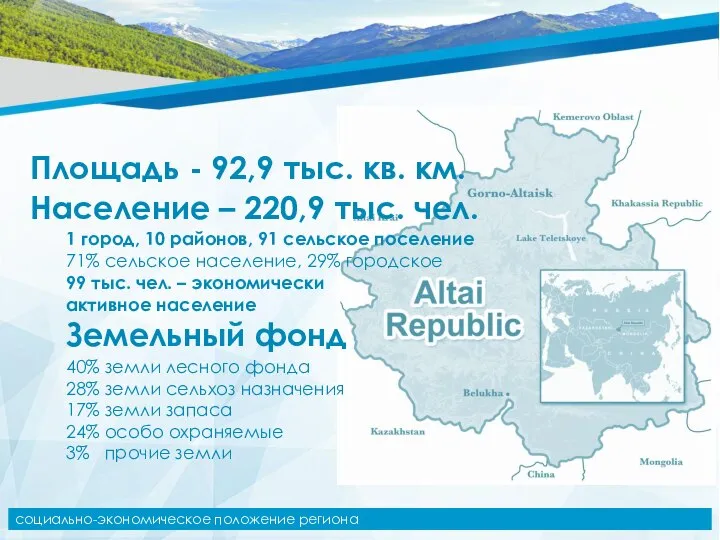 Инвестиционный потенциал Алтайского края