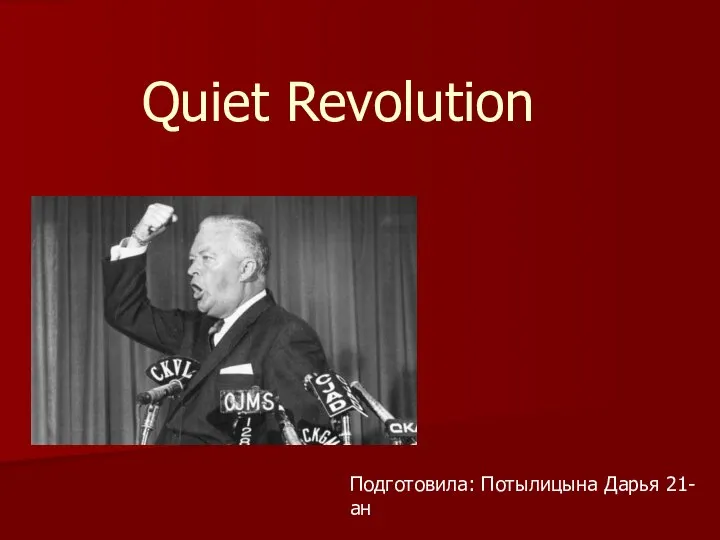
Quiet Revolution
The Quiet Revolution (French: Révolution tranquille) was a period of intense socio-political and socio-cultural change in the Canadian province of Québec, characterized by the effective secularization of government, the creation of a state-run welfare state (état-providence), and realignment of politics into federalist and sovereigntist (or separatist) factions and the eventual election of a pro-sovereignty provincial government in the 1976 election. The Quiet Revolution typically refers to the efforts made by the Liberal government of Jean Lesage (elected in 1960), and sometimes Robert Bourassa (elected in 1970 after the Union Nationale's Daniel Johnson in 1966), though given the profound effect of the changes, most provincial governments since the early 1960s have maintained an orientation based on core concepts developed and implemented in that era. The Quiet Revolution began with the enacted Liberal provincial government of Jean Lesage, who was elected in the June 1960 provincial election, shortly after the death of Premier Maurice Duplessis, whose tenure was known by some as the Grande Noirceur (Great Darkness), but viewed by conservatives as epitomizing a religiously and culturally pure Québec. Prior to the 1960s, the government of Québec was controlled by the conservative Duplessis, leader of the Union Nationale party. Not all the Catholic Church supported Duplessis - some Catholic unions and members of the clergy criticized him, including Montreal Archbishop Joseph Charbonneau - but the bulk of the small-town and rural clergy supported him. Prior to the Quiet Revolution, the province's natural resources were developed mainly by foreign investors.In the spring of 1949, a group of 5,000 asbestos miners went on strike for three months. The 1949 Asbestos Strike found Québécois miners united against a nationalist foreign corporation. Political activist and singer Félix Leclerc described this phenomenon, writing, "Our people are the waterboys of their own country." In many ways, Duplessis's death in 1959, quickly followed by the sudden death of his successor Paul Sauvé, triggered the Quiet Revolution. The Liberal Party, led by Jean Lesage and campaigning under the slogans "Things have to change" and "Masters of our own house", a phrase coined by Le Devoir editor André Laurendeau), was voted into power within a year of Duplessis's death. It is generally accepted that the revolution ended before the October Crisis of 1970, but Québec society has continued to change dramatically since then, notably with the rise of the sovereignty movement, evidenced by the election of the sovereignist Parti Québécois, the formation of a sovereignist political party representing Québec on the federal level, the Bloc Québécois as well as the 1980 and 1995 sovereignty referendums. Some scholars argue that the rise of the Québec sovereignty movement during the 1970s is also part of this period.
 Slaidy.com